
When an installer asks for an ESS quotation in 2026, the first question is rarely just battery size. We need to confirm the tariff spread, backup load list, grid phase, existing inverter model, export rules, and whether generator support is needed. In that conversation, an energy storage system, usually shortened to ESS and often called a battery energy storage system or BESS, means the battery-based system that stores electricity and releases it when the site can use it better: after sunset, during peak tariffs, or during an outage. Solar output arrives around midday, household demand peaks in the evening, and many grids charge very different prices across the day. Storage closes those gaps.
At LuxpowerTek, we design hybrid inverters, LiFePO₄ battery cabinets, and all-in-one energy storage units for residential and commercial projects. In a typical quotation workflow, our team first checks the site’s load profile, grid conditions, existing equipment, and backup target, then matches the inverter model, battery voltage, usable capacity, surge rating, communication protocol, and expansion path into a field-ready configuration.
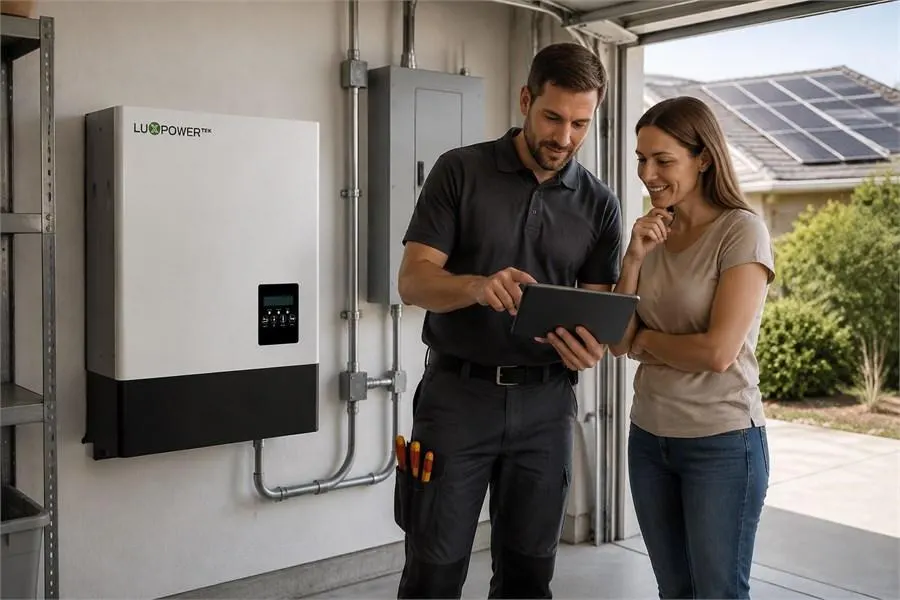
For 2026 projects, three changes come up more often in our specification work. Certification and grid-code checks are increasingly tied to the exact model code in AHJ reviews, utility interconnection applications, customs or import approval, and tender compliance documents, rather than accepted at brand level. More residential buyers want backup-ready systems instead of simple solar self-consumption upgrades. C&I buyers are also asking for three-phase storage, peak shaving, demand-charge control, and remote monitoring. That is why ESS selection now has to connect the commercial case, electrical design, and exact inverter-battery configuration before hardware is ordered.
What Storage Does That a Solar Array Alone Cannot
A solar array can only produce electricity when sunlight is available. An energy storage system adds the missing function: it stores surplus solar power and releases it when the home or business actually needs it.
In practice, that means a battery can do three things a solar array alone cannot. It can shift midday solar generation into the evening peak, reduce reliance on expensive grid power when tariffs rise, and keep selected loads running during an outage. In many markets where export compensation is lower than retail rates, a grid-tied PV system without storage sends unused solar electricity back to the utility at a lower value than the price paid later in the day.
The scale of this shift is easy to underestimate. In its August 2026 update, the U.S. Energy Information Administration reported that U.S. utility-scale battery capacity grew by an average of about 70% per year over the previous three years, reaching 43.6 GW by the end of 2025 and nearly 52 GW after operators added 8.3 GW in the first half of 2026. Those figures refer to large grid-connected projects, not household systems, but the underlying logic is the same: stored energy is more useful when it can be used at the right time.
The Four Parts Inside Every Storage System
Four building blocks determine how an ESS performs, and each one creates a different on-site check before the system can be quoted or commissioned safely.
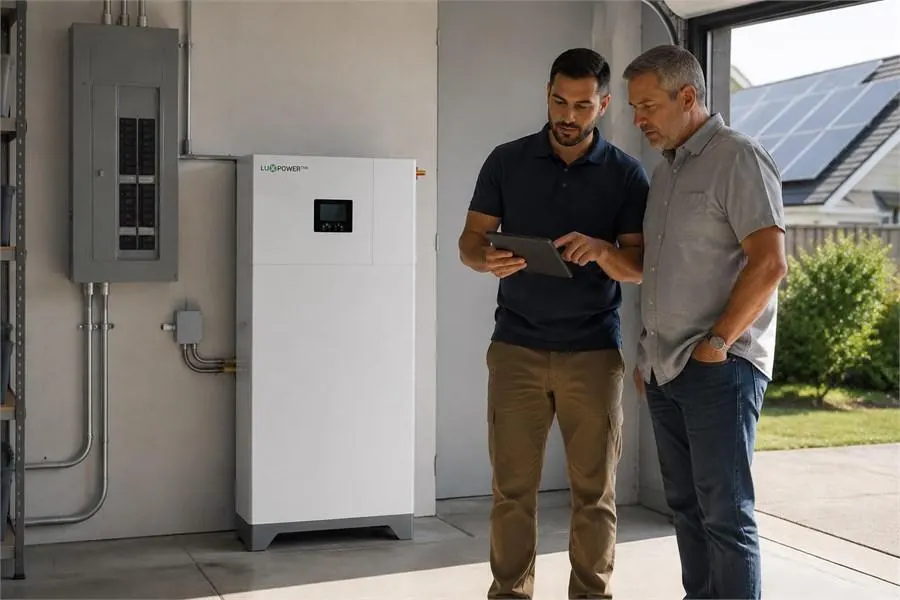
1. Battery
The battery sets usable capacity in kilowatt-hours and, with its chemistry, sets cycle life and temperature behaviour. Most home energy storage systems now use lithium iron phosphate cells for their thermal stability and long cycle counts. In the field, the mistake we try to catch early is matching only the kWh number while missing the battery voltage, maximum charge and discharge current, enclosure rating, installation temperature range, or whether the pack appears on the inverter’s compatibility list.
2. Battery Management System
The battery management system watches cell voltage, current and temperature, balances the pack and stops charging or discharging outside safe limits. Its second job matters just as much in practice, because the BMS has to speak the same communication protocol as the ESS inverter. Mismatched CAN or RS485 communication, abnormal SOC reading, repeated BMS alarms, firmware mismatch, or a battery that is missing from the inverter-battery compatibility list are some of the most common causes of commissioning delays we see in support tickets.
3. Power Conversion Stage
The power conversion stage decides how power is split between loads, battery, grid and generator. In a modern solar-plus-storage system that stage is a hybrid inverter, which also runs the MPPT trackers for the PV array. Before we confirm a model, we check PV string voltage and current against the MPPT window, the site phase type, EPS or backup output requirements, generator or smart-load ports, and whether the project may need parallel expansion later. A system can look right on battery capacity and still fail if the inverter cannot handle the PV input, surge load, or grid connection requirement.
4. Energy Management Layer
The energy management layer turns hardware into savings, covering time-of-use charging, peak shaving, backup reserve settings and remote firmware updates. Without visibility through an app or portal, an owner has no way to tell whether the system is doing what it was sold to do. For installers, the practical checks are whether tariff schedules are entered correctly, backup reserve is not set too low, alarm notifications reach the right account, and remote monitoring is active before handover. Otherwise, an avoidable warning can sit unnoticed until the next outage or high-tariff period.
What Changes When Batteries Are Added to an Existing PV System
Retrofits follow a different logic from new builds, and the deciding question is what happens to the existing inverter. DC coupling routes the array through a hybrid inverter handling both PV and battery, which is efficient for a fresh installation, though it usually means replacing hardware that still works. AC coupling adds a battery inverter alongside the existing grid-tied unit, so the original PV system keeps running untouched. Our article on DC vs AC coupling covers the trade-off in more detail.
Most residential and light-commercial enquiries fall into four patterns.
|
Configuration |
Strengths |
Trade-offs |
Typical fit |
|
DC-coupled hybrid |
One inverter for PV and battery, fewer conversion steps, direct DC charging |
Existing string inverter is usually replaced, and PV design must match the hybrid unit |
New residential and light commercial solar-plus-storage builds |
|
AC-coupled retrofit |
Existing PV system stays in service, lower installation risk, easy expansion later |
Extra conversion stage, second inverter to site and commission |
Homes with a healthy grid-tied inverter or microinverters |
|
All-in-one ESS cabinet |
Inverter and battery pre-integrated, fast installation, small footprint |
Capacity steps fixed by the cabinet, less freedom in battery choice |
Standard residential loads, load-shedding backup, shops and workshops |
|
Commercial energy storage cabinet |
Higher power, three-phase output, peak shaving against demand charges |
Site study, switchgear work and utility approval add lead time |
Factories, clinics, schools and commercial buildings |
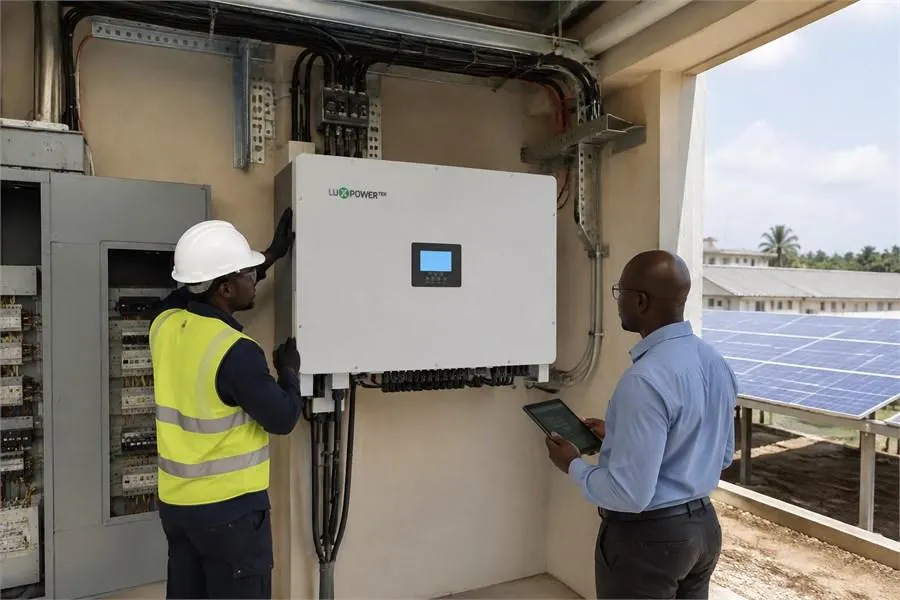
The last row is worth separating from the first three. Commercial and industrial storage is a distinct product path with its own protection, switchgear and approval requirements, and it is not a larger version of a residential all-in-one cabinet. Where a project sits in that category, the specification should start from the C&I equipment listed in our product centre and a conversation with our engineers, rather than from a home ESS datasheet.
Our guidance on retrofits is blunt. Where the existing string inverter is healthy, correctly sized and still under warranty, AC coupling is normally the cheaper and lower-risk path, and our LXP ACS 3600 AC-coupled inverter exists specifically for that job, with a dedicated EPS port so backup circuits stay supported. Where the inverter is nearing end of life, or where the customer wants whole-home backup and generator support in one box, replacing it with a hybrid unit tends to produce a cleaner system with fewer conversion steps. Local grid connection rules can override both preferences, so the utility’s requirements should be confirmed before any hardware is ordered.
When Storage Pays Back, and When It Mostly Sits Idle
Storage earns its cost in three situations, and struggles outside them.
The clearest case is a wide gap between peak and off-peak tariffs. A battery charged overnight or from midday solar and discharged into the evening peak captures that spread every day of the year.
The second case is a low export rate paired with high evening consumption. Households that generate well and consume little during daylight hours give away most of their production, and self-consumption climbs sharply once a battery absorbs it.
The third case is unreliable supply. For customers facing regular load shedding or storm-related outages, the value is straightforward: keeping refrigeration, pumps, routers, lighting, trading equipment, or essential home circuits running when the grid fails. That is why our sales team fields so many enquiries about backup performance during frequent outages.
Where a flat tariff meets a generous export rate and a stable grid, payback stretches out. Our working test is whether the tariff spread and the solar surplus together can cycle the battery close to daily. If the pack would sit at high state of charge for most of the week, the extra kilowatt-hours earn nothing, and we would rather quote a smaller system than see a partner defend an oversized one two years later.
How to Size an ESS Without Overbuying
Two numbers drive sizing, and they answer different questions. Capacity in kilowatt-hours decides how long the system runs, and it comes from the loads that need covering between sunset and sunrise. Power in kilowatts decides what can run at the same time, governed by the largest simultaneous draw, including motor start-up surges from pumps, compressors and air conditioning.
A worked example makes the difference obvious. A rural household lists a fridge, freezer, lighting, router, a few sockets and a well pump as essential, adding up to roughly 3 kWh across the night, which suggests a modest battery. The well pump, though, draws several times its running power for a second or two at start-up, and when that coincides with a fridge compressor restart, the peak rating decides whether the system rides through or trips. Sizing on the 3 kWh alone produces a system that fails on the first night it is needed.
Future load growth deserves a line in the calculation too, since heat pumps and EV chargers change the picture quickly, and parallel-capable equipment leaves room to expand without replacing the original unit.
Before asking for a quotation, it is worth collecting the eight items below. They are the same inputs our engineers work from, and they are what our inverter and battery sizing tool asks for:
-
Essential loads that must stay live during an outage
-
Night-time consumption in kWh
-
Peak simultaneous demand in kW
-
Surge loads such as pumps, compressors and air conditioning
-
Grid phase on site: single-phase, split-phase or three-phase
-
Required backup duration
-
Battery voltage and the pack already installed, if any
-
Certification required in the destination market
Choosing the Right Luxpower Configuration for a Project
Every storage project starts with a different site constraint: the grid type may be fixed, backup loads may need generator support, wall space may be limited, or the customer may want room to expand later without replacing the first system. For new residential and light commercial installations, our hybrid inverter range gives installers a practical starting point for solar self-consumption, backup power, time-of-use control, or future parallel expansion. The final model still needs to be checked against the exact datasheet for phase type, power rating, battery compatibility, generator input, smart-load support, and local grid requirements.
For the latest product categories, installers can also review the LuxpowerTek product range, which includes hybrid inverters, off-grid inverters, AC/DC-coupled solutions, all-in-one ESS products, battery storage and monitoring accessories. The best configuration is selected by application, grid phase, power range, battery voltage, destination market and required certification.
Which Luxpower product option fits the project?
-
New PV-plus-storage home or small commercial project: Start with our LuxpowerTek hybrid inverter. Choose the appropriate single-phase, split-phase or three-phase series, then match PV voltage, inverter power, battery voltage, backup output, generator support and parallel capability.
-
Existing PV system that should remain in service: Consider an AC-coupled option such as the LXP ACS 3600, subject to the existing inverter’s output, battery compatibility, backup architecture and local interconnection rules.
-
Weak-grid, off-grid or backup-first project: Review the LuxpowerTek off-grid and Eco-Hybrid inverter options, including the SNA series, with special attention to generator input, battery voltage, surge capacity and the required backup circuits.
-
Fast residential installation with limited space: The Eco Beast Pro all-in-one ESS combines the inverter and battery in one cabinet. The current product information lists 10 kWh and 15 kWh battery configurations, 6.5 kW continuous output, 13 kW peak surge, up to 9.6 kW PV input, 90 V to 280 V AC input and a dedicated GEN port.
-
Flexible, step-by-step capacity expansion: Compare a modular all-in-one option such as Eco Beast with a separate hybrid inverter and battery system. A modular battery design may suit buyers who prefer to add capacity gradually, while a fixed 10 kWh or 15 kWh configuration may simplify installation and reduce the number of external connections.
-
Battery replacement or storage expansion: You can review our LuxpowerTek battery storage range. Options include low-voltage products such as Li-5, PGEM, PGEM PRO and PSHIELD, as well as high-voltage PSTACK solutions. The final choice depends on inverter compatibility, usable capacity, enclosure rating, installation location, communication protocol and expansion requirements.
-
Three-phase commercial and industrial project: Start from the three-phase hybrid and commercial product categories, then confirm peak-shaving requirements, demand charges, switchgear, protection, metering, export control, fire-safety documentation and utility approval with the engineering team.
For projects that need an integrated system, we may recommend the Eco Beast Pro all-in-one ESS. It combines the inverter and LiFePO₄ battery in one cabinet, with standard 10 kWh or 15 kWh configurations, 6.5 kW rated output, 13 kW peak surge and a 90 V to 280 V AC input range. We first confirm the load profile, cabinet space, maintenance clearance, backup requirements and local installation rules.
If the inverter is already installed and only additional storage is needed, we first verify battery compatibility. Our selection covers voltage class, usable capacity, charge and discharge current, BMS communication, enclosure rating, installation conditions and expansion limits. Available options are listed on the LuxpowerTek battery storage page. The final battery must match the exact inverter and system configuration, and installation should be completed by a qualified professional.
How to purchase and specify a LuxpowerTek system
-
Share the project basics. Provide the installation country, grid phase, PV size, existing inverter, essential loads, peak demand, backup duration, tariff structure, generator requirements, quantity and project type.
-
Choose the right system category. Start with the product centre and inverter and battery sizing tool to compare hybrid, off-grid, AC-coupled, all-in-one, battery and three-phase solutions.
-
Match the exact equipment. We will check the model code, rated and surge power, MPPT range, battery voltage, compatible battery models, CAN or RS485 communication, generator and smart-load functions, parallel operation and required accessories.
-
Review documents before ordering. Check the latest datasheet, user manual, battery compatibility list, certificates, warranty terms and installation requirements in the LuxpowerTek download centre. Requirements may vary by market and model.
-
Request a quotation. Send the project details, preferred configuration, quantity, delivery country and required documents through the LuxpowerTek contact page. Our team can then confirm the final SKU, availability, lead time, shipping and payment terms, warranty coverage, local support and purchasing route.
-
Compare the complete system cost. Include the inverter, battery, communication devices, CT or meter, cabling, protection equipment, mounting hardware, shipping, duties, installation, commissioning and permitting—not only the battery capacity or unit price.
-
Check delivery and commissioning. Verify the model codes, serial numbers, manuals, certificates, accessories and packing list on arrival. A qualified installer should then configure the operating modes and backup reserve, activate monitoring, test the backup output and record the final settings for handover.
A quotation is not complete until it identifies the exact inverter, exact battery, compatible communication method, certification route and installation assumptions. Availability, regional certification, distributor coverage, minimum order quantities and delivery times can vary by market, so buyers should confirm these items with us or our authorised sales channel before payment.
Safety, Certification and the Rules That Vary by Market
Certification is a system-level question. UL 9540, the standard for energy storage systems and equipment, assesses charging and discharging, protection, control and communication between devices as an integrated system, and many North American authorities having jurisdiction require or prefer UL 9540-listed systems on code-driven projects. Grid interaction is covered separately, and our split-phase models carry certifications relevant to that market, including UL 1741 and IEEE 1547 requirements.
These requirements are regional. European, Australian and South African installations follow different grid codes and documentation, and a certificate valid in one market carries no weight in another. Anyone specifying equipment for export should treat the destination market’s rules as the starting point, and our regional teams confirm which certificates apply to a given model before an order is placed.
Certificates are held per model rather than per brand, so the check has to be made against the exact model code and the exact destination market. The current certificates, together with datasheets, manuals and battery compatibility lists, sit in our download centre, and it is worth confirming them there before a bid or a customs declaration is prepared.
Common ESS Questions Before Buying
What is the difference between ESS and BESS?
ESS is the broader term and covers any technology that stores energy for later release, including pumped hydro, flywheels and thermal storage. BESS narrows that to battery-based systems, which is what almost every residential and commercial project means in practice, so the two terms are often used interchangeably in solar contexts. A second distinction matters more on site: a battery cabinet is only the storage component, while an ESS or BESS is the complete system, including the conversion stage, the BMS and the energy management layer that decides when the battery charges and discharges.
What types of energy storage systems are available?
Three families cover most projects. Wall-mounted or floor-standing residential units serve homes and small shops, commercial energy storage cabinets handle three-phase loads and demand charges, and containerised BESS units serve utility and large industrial sites. The electrical principles are shared, and the differences lie in power rating, protection, cooling and approval process.
What actually drives the cost of a home energy storage system?
Battery capacity dominates the bill of materials, followed by the inverter power rating. Installation cost then varies widely by site, since switchboard modifications, cable runs, backup circuit separation and permitting can shift the total well beyond the hardware price, which is why two quotations for identical equipment often differ.
How long does a battery last?
Lifespan is expressed in cycles and in years, and LiFePO₄ packs are built for a high cycle count under normal residential use, with depth of discharge, ambient temperature and charge rate all influencing how quickly capacity fades. Warranty terms differ by model and by market, so the warranty document supplied with the selected product is the figure that counts.
Does an ESS need maintenance?
Very little. Keeping ventilation clear, checking terminals during periodic electrical inspections, applying firmware updates and reacting to monitoring alerts covers most of what an owner needs. Unmonitored systems are the ones that surprise people, because a fault flagged in the app for months goes unnoticed until backup is needed.
Can a battery run an entire house?
Sometimes, and the answer depends on the inverter’s continuous and surge rating more than on stored capacity, since whole-home backup requires the inverter to pass through the full service current and start every motor load in the building. Many households find it cheaper to back up a critical loads panel and leave high-draw circuits on the grid.
Getting a System Specified Properly
To turn those three inputs into a usable specification, prepare six details before requesting a quote: the load list, tariff plan, existing inverter model if there is one, grid phase, essential circuits that must stay live during an outage, and whether generator support is required. You can run the first sizing estimate in our sizing tool, then send the result to our engineering team for model selection and configuration review. Bringing the design to us before hardware is ordered is far cheaper than correcting an oversized, underpowered or incompatible system after commissioning.