

The best home battery backup system in 2026 is the one sized to the loads a household keeps running during an outage, built on lithium iron phosphate cells, and matched to an inverter that absorbs motor surge without tripping. No single model wins for every house, so the practical question is which configuration fits a given load profile.
We build inverters and storage batteries at LuxpowerTek, and most of the specification problems our engineering team resolves trace back to a mismatch between capacity and current delivery. A homeowner buys plenty of kilowatt hours and then finds the system cannot start the air conditioner. The sections below work through that selection logic in the order we use with installers.
Start With the Loads You Need to Keep Running
Most households land between 10 kWh and 20 kWh for essential loads, and above 30 kWh for whole house battery backup. The arithmetic is straightforward. A refrigerator, lighting, routers, a few outlets and one small comfort zone usually consume somewhere between 5 kWh and 10 kWh across a day, so a mid size battery carries them through an overnight event with margin remaining. Whole house coverage adds HVAC, electric water heating and laundry, and those loads scale the requirement up quickly.
| Factor | Essential load backup | Whole house backup |
| What stays powered | Fridge, lights, internet, small comfort loads, medical devices | Every circuit, including HVAC, water heating and laundry |
| Typical daily draw | Around 5 kWh to 10 kWh | Close to normal household consumption |
| Battery capacity | 10 kWh to 20 kWh | 30 kWh and above |
| Inverter demand | Moderate, single phase usually sufficient | High continuous and surge rating required |
| Installed cost | Lower, fewer modules and simpler wiring | Substantially higher |
The context behind this spending is worth noting. According to the U.S. Energy Information Administration, electricity customers in the United States averaged around 11 hours of interruptions in 2024, close to double the annual average of the preceding decade, with major weather events accounting for roughly 80 percent of those hours. Those figures describe the United States, and outage patterns differ widely by country, so local data matters more than any national average when setting a backup target.
Our free inverter and battery sizing calculator walkthrough steps through appliance selection and backup duration without requiring an electrical background. Working through it before requesting quotations saves a round of revisions and gives a household a defensible number to bring to an installer.
Why Surge Current Matters in Real Backup Systems
Many backup problems have nothing to do with a shortage of capacity. They happen in the first second after a motor starts. A system can hold enough kilowatt hours to run a load for hours and still fault when the battery and inverter cannot carry the startup current.
One case from our after sales team shows this clearly. A household on a 48V system found the inverter faulted every time the borehole pump started during an outage. The same pump worked normally with the grid available, and state of charge was high at each fault, so runtime was never the issue.
The event log pointed to an over current trip lasting less than a second, landing exactly on pump start. On paper the running load looked manageable. The pump drew about 1.1 kW, roughly 23A on the DC side at 48V, against a module rated at 100A continuous discharge. The startup spike was the problem. With direct on line starting, the pump demanded several times its running current for a brief moment, pushing past the module surge limit of 105A for 15 seconds and 150A for 500 milliseconds.
The fix was simple. Adding a second module in parallel raised available continuous discharge to about 200A and split the startup demand across two BMS units. Neither module reached its protection threshold, and the faults stopped with no change to the inverter or the pump.
That experience changed how we review configurations. Where a home includes a pump, compressor, HVAC unit or workshop tool, we ask installers to confirm starting current alongside running wattage before we propose a battery setup. A few minutes of checking at quotation stage prevents a service visit after installation.
Low Voltage Battery Backup for Most Homes
Low voltage systems around 48V remain the practical default for single family homes. Below roughly 20 kWh the wiring stays simple, the component count is low, and installed cost usually comes in under a high voltage equivalent. Two configurations cover almost every household in this bracket.
PSHIELD for Essential Loads
A household covering a fridge, lighting, network gear and a modest comfort load needs a starting point that expands later without rework. Our PSHIELD answers that at 5.12 kWh per module on a 51.2V platform, with parallel expansion available as consumption grows.
The module size is the point. Adding capacity happens in small increments, which keeps the initial spend low and lets a household build toward a larger reserve over a few seasons. Where a large motor load sits on the backup circuit, a single small module reaches its current ceiling before its energy ceiling, so that situation calls for the larger platform below.
PSHIELD MAX for Whole House Battery Backup
When backup needs to cover pumps, HVAC, refrigeration, lighting and outlets together, the system needs longer runtime and higher discharge headroom at the same time. That is where PSHIELD MAX fits, with 16.076 kWh of storage per module and 314Ah LiFePO4 cells.
The current headroom does the work that capacity alone cannot. PSHIELD MAX supports 105 percent load, meaning 210A, for 120 seconds, and 110 percent load, meaning 220A, for 500 milliseconds, which gives the system room to ride through compressor and pump startup at the moment backup power matters most. Parallel expansion to 32 units means a household can begin with whole house coverage and extend it later without changing architecture.
This platform suits homeowners wanting multi day coverage, a path from essential load backup toward full home backup, or a system that handles motor loads without careful load shedding. Each module weighs 119 kg, so the installation plan should include a suitable mounting location and proper handling during placement.
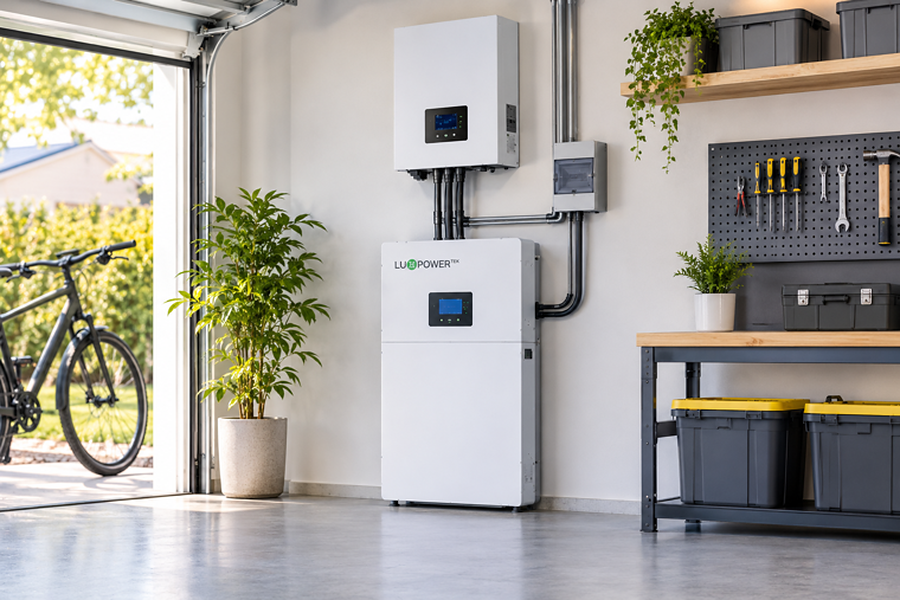
High Voltage Storage for Larger Homes and Mixed Use Properties
Larger properties present a different problem. Heat pumps, EV charging, workshops and light commercial loads push current demand high enough that a low voltage layout becomes awkward to cable and expand. Our PSTACK system addresses those projects with a high voltage stacked architecture, configurable from 10 kWh to 40 kWh per unit and expandable to 20 units in parallel for a maximum near 800 kWh.
At the same power level, a higher system voltage moves less current, which reduces cable size and conversion losses and keeps large installations cleaner to design and maintain. For a modest home below roughly 20 kWh the added complexity rarely pays for itself, and a low voltage system remains the better choice.
When an All in One System Makes Sense
For households that prefer a pre matched inverter and battery package, an all in one energy storage system can simplify installation and support. The trade off is flexibility, since a property expecting significant load growth generally does better with separate components that expand module by module.
Matching the System to the Need
| User need | Better fit | Why |
| Basic essential load backup | PSHIELD | Smaller 5.12 kWh module, easy incremental expansion |
| Longer runtime or whole house backup | PSHIELD MAX | Larger 16.076 kWh module and higher current headroom |
| Large home, EV charging, heat pump, light commercial | PSTACK | High voltage architecture for larger scalable systems |
All three platforms carry IP65 enclosures and a 10 year warranty, with published cycle life above 6,000 for PSHIELD, above 8,000 for PSHIELD MAX, and up to 6,000 for PSTACK. Those figures follow our own product pages and describe our equipment rather than any industry wide benchmark, so comparisons belong against each manufacturer’s own documentation.
Solar Battery Backup Compared With Battery Only
Pairing storage with solar changes the runtime maths, because the array recharges the battery during daylight and turns a fixed reserve into a renewable one. A grid tied solar system without storage shuts down during an outage for line worker safety, so panels alone provide no backup at all. Our guide on hybrid inverters compared with off grid inverters sets out where each architecture fits.
Home battery backup without solar remains a valid configuration. The battery charges from the grid during cheap hours and discharges during expensive ones or during an outage. EIA data puts average monthly residential consumption at about 865 kWh in 2024 at an average price of 16.5 cents per kWh, so payback in that setup rests on the local tariff spread and outage frequency.
Safety, Warranty and Local Installation Checks
Chemistry does most of the safety work. Lithium iron phosphate is more thermally stable than the nickel based chemistries used in many consumer electronics, which is why it dominates residential storage. A capable battery management system handles the rest, covering over charge, over discharge, over current, abnormal temperature, short circuit and reverse polarity conditions. Every residential battery we produce carries that protection set as standard.
Certification requirements are regional and should be checked locally. North American installations commonly reference UL 9540 at system level along with NFPA 855 for installation, while European, African and Asian markets apply their own frameworks. Requesting the certificates valid in a given jurisdiction, and confirming the installer holds relevant accreditation, is a reasonable step before signing anything.
FAQs
How long can a 10 kWh battery power a house?
A 10 kWh battery typically covers essential loads for roughly one day, and whole house loads for a few hours. Essential circuits drawing around 400W average consume about 9.6 kWh across 24 hours, which fits. A house running central air conditioning at 3 kW would exhaust the same battery in about three hours, before conversion losses.
Can a home battery run an air conditioner?
Yes, provided both the inverter and the battery carry sufficient surge headroom for compressor startup. Running wattage alone gives an incomplete picture, because startup current can reach two to three times that figure for a second or so. Inverter driven units place gentler demands on a system than fixed speed compressors do.
Is LiFePO4 better for home backup?
For residential storage LiFePO4 is generally the stronger choice, mainly on thermal stability and cycle life. It carries lower energy density than nickel based chemistries, which matters in a phone or a vehicle and matters much less in a wall mounted or floor standing home battery.
Home battery backup versus a generator, which suits a household better?
A battery suits frequent short outages and daily bill management, while a generator suits rare multi day events where fuel can be resupplied. Batteries run silently and need no fuel. Generators sustain output for as long as fuel lasts, though they require maintenance and produce noise and emissions. Some households run both.
Does a home battery work without solar panels?
It does. The battery charges from the grid, typically during off peak hours, and discharges during peak hours or an outage. The economics then depend on the tariff spread available and on how often the grid fails locally.
Next Step
Send us an appliance list and a target number of backup hours, and our engineering team will return a configuration with the battery count, inverter model and expected runtime. Regional partners handle installation and commissioning from there. The quickest route is to contact us, and the appliance list matters more than any other detail at that stage.
Sources
- U.S. Energy Information Administration: Hurricanes in 2024 led to the most hours without power in the United States in 10 years
- U.S. Energy Information Administration: Residential electric bills in Hawaii and Connecticut are twice those in New Mexico, Utah