
At LuxpowerTek, we recommend an all in one energy storage system when its available configurations match your loads and installation space. A separate inverter and battery is often a better fit when you need independent sizing, flexible placement, or a specific retrofit arrangement. Both approaches can work well; the deciding factors are compatibility, usable capacity, backup output, expansion options, and total installed cost.
What Is the Main Difference Between the Two Systems?
The main difference is how the inverter and battery are packaged and matched. An all-in-one ESS combines them into a coordinated product platform. A separate system connects an independently selected inverter to an external battery bank.
Our range supports both approaches. Eco Beast Pro combines inverter and battery storage, while the GEN3-LB-EU 3–8K hybrid inverter works with compatible external 48 V batteries. For a complete comparison, select a specific GEN3 model and compatible battery configuration.
| Decision factor | All-in-one ESS | Separate inverter + battery |
| Equipment matching | Specified inverter and battery combination | Pairing must be verified |
| Installation layout | Consolidated equipment footprint | More freedom to position components |
| Capacity selection | Available integrated configurations or modules | Battery bank sized within inverter and battery limits |
| Expansion | Depends on the platform’s supported expansion method | Battery capacity may grow without replacing the inverter |
| Backup performance | Determined by output, battery limits, and configuration | Determined by the same electrical constraints |
| Servicing | Check access to individual modules | Check component replacement and supplier responsibilities |
Which System Is Easier to Install?
An all-in-one system generally offers a simpler installation, while separate components provide more freedom to position the inverter and battery.
Eco Beast Pro combines inverter and battery storage in one coordinated package, simplifying equipment matching and layout for a new installation. Installation still includes mounting, electrical protection, earthing, solar and AC connections, and commissioning. An integrated package does not remove the need for a qualified installer or compliance with local requirements.
Compare the usable installation area, including ventilation and service access. A narrow cabinet can still require substantial clearance. Separate equipment may fit better where an existing inverter position and an approved battery location cannot be combined.
Environmental protection also changes the choice. Eco Beast Pro has an IP20 rating, whereas the GEN3-LB-EU inverter has IP66 protection. The external battery needs its own suitable rating. Select an installation location that meets the requirements of both the inverter and battery, including environmental protection, ventilation, and service clearance.
Which Offers More Flexibility for Sizing and Expansion?
Separate components usually offer more freedom to size battery capacity independently of inverter power, but integrated systems can also be expandable. The useful comparison is the supported upgrade path.
Battery capacity, measured in kWh, determines how much energy is available. Inverter output, measured in kW, limits how much power can be supplied at once. A household may need more stored energy for overnight use without needing a higher inverter rating. Another may need greater output for simultaneous appliances without needing a much larger battery.
With GEN3, you can select compatible battery capacity around your runtime needs while choosing inverter power for the appliances that must operate together. Adding batteries while retaining the inverter depends on battery current limits, permitted module quantities, wiring, and expansion rules. Extra capacity does not automatically increase the inverter’s rated output.
Eco Beast, another model in our all-in-one ESS range, uses modular battery packs. Its expansion options should be assessed separately from Eco Beast Pro, including whether an upgrade adds battery modules or another complete system.
Before expanding, confirm whether newer batteries can be added to an older bank and what installation work is required.
Does Either Architecture Provide Better Backup Power?
Neither architecture guarantees better backup. What matters is the inverter’s continuous output and surge capability, the battery’s available energy, and which circuits you need to keep running.
Eco Beast Pro has a rated backup output of 6.5 kW and can provide twice that power for up to five seconds. That brief surge can help start some motors and compressors, but the continuous output and the battery’s discharge capability must still be sufficient for the loads you plan to run.
Start by listing the appliances you want powered during an outage and which ones may run at the same time. A refrigerator, lights, and internet equipment place different demands on a system than a heat pump, electric cooking, or water heating. More battery capacity can extend runtime, but it does not raise the inverter’s output limit.
We recommend asking your installer which circuits will receive backup power, whether the system matches your home’s phase configuration, and whether solar can recharge the battery during an outage. Runtime also depends on the battery’s state of charge, reserve settings, conversion losses, and actual consumption.
For example, if 8 kWh is available at the AC output after reserve and losses, the estimated runtime is about eight hours at an average 1 kW load, or four hours at 2 kW. This is an illustrative calculation, not a product runtime guarantee, and it does not include additional solar generation during the outage. Check that the inverter and battery can also handle peak loads and appliance startup.
Is an All-in-One System More Efficient or Better for Retrofitting?
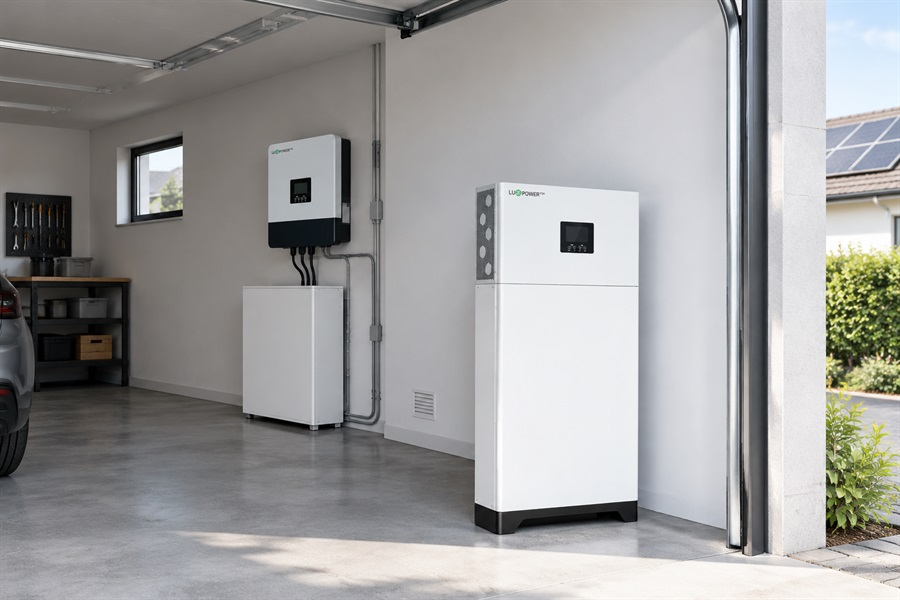
An all-in-one system is not inherently more efficient, and separate components are not automatically better for every retrofit. Efficiency and retrofit suitability depend on the electrical connections and equipment already installed.
A separate hybrid inverter and external battery can form a DC-coupled system. Solar energy can charge the battery without first being converted to AC. An integrated system can use the same basic power path. Physical separation does not, by itself, add an AC conversion stage.
AC coupling can be useful when retaining an existing solar inverter. In that arrangement, solar output is converted to AC, then back to DC when charging the battery. The AC and DC coupling options therefore deserve a separate check from the enclosure decision.
Establish which existing equipment is worth retaining, then compare compatible designs. Ask for efficiency figures covering the same energy path and operating conditions. Also verify export control and outage operation. An arrangement that charges successfully while the grid is present may need additional compatibility checks to keep solar operating during a blackout.
For example, compare solar-to-battery-to-load performance on both proposals. A maximum PV-to-AC inverter efficiency and a battery charge-discharge efficiency describe different processes. Placing those percentages side by side would not establish which complete storage system delivers more useful energy.
Which Has the Lower Total Installed Cost?
Compare quotes with the same usable battery capacity, continuous backup output, and backed-up circuits. Include installation work and the cost of your most likely future upgrade.
An integrated package can reduce some equipment-matching and installation tasks. Separate components can avoid purchasing excess inverter power when the priority is additional storage. Either advantage can disappear if the design needs substantial switchboard work, long cable runs, extra protection, or expensive equipment relocation.
Keep monitoring scope and commissioning work consistent between quotes. Include mounting, protection devices, meters or sensors, and any required changeover equipment. Check whether delivery and installation labour are included.
Record exclusions in writing. Two quotes with similar equipment can cover very different work, particularly when one includes backup-circuit preparation and the other leaves it for a separate contractor.
Price the most likely expansion before committing to either design. A modest initial saving may be less attractive if the next capacity increase requires another complete system. Conversely, paying for flexibility you are unlikely to use can increase the initial bill without improving the installation.
Which Is Easier to Maintain and Repair?
Separate components can be easier to replace individually, but some all-in-one systems also allow individual modules to be serviced or replaced. For either setup, check which parts can be replaced, which replacement models are compatible, and how repairs are handled.
Our LuxCloud platform lets you monitor both Eco Beast Pro and GEN3 remotely. The battery data and diagnostic functions available depend on the selected battery configuration. This information can help identify whether a problem comes from the battery, inverter, or system settings.
Warranty coverage for our products depends on the model and market. Check the warranty terms for your chosen inverter and battery. Before purchasing, ask your supplier who handles fault diagnosis and replacements, and whether labour and transport costs are covered.
Which System Should You Choose for Your Home?
Choose an all in one energy storage system when a supported configuration meets your load, storage, and location requirements with a simpler installation. Choose separate components when independent sizing, equipment placement, or retention of existing assets provides a clear advantage.
- New solar-plus-storage installation: Start with an integrated option when its output and capacity fit the design.
- Existing solar installation: Compare a compatible retrofit with inverter replacement before selecting the enclosure format.
- Expected growth in overnight consumption: Prioritize a documented battery expansion path.
- High simultaneous loads: Prioritize inverter output, battery discharge capability, and phase requirements.
For separate components, use the relevant battery compatibility resources to verify the exact pairing, communication protocol, and applicable firmware requirements. Matching nominal voltage is only one part of that check.
To compare our integrated and separate-component options, contact us with your existing equipment, essential loads, target backup duration, and installation location. Those details give the choice between integrated storage and separate components a practical starting point.
FAQ
Can I use an all-in-one energy storage system without solar panels?
Yes, if the system supports grid charging. Eco Beast Pro can charge its battery from an AC supply, so solar panels are not required for that charging mode. Confirm the grid-charging settings and connection requirements for your selected model before choosing a battery-only installation.
Will my storage system keep working if the internet goes down?
Usually, yes. Locally controlled charging and discharging can continue, while LuxCloud remote monitoring and online control need an internet connection. Use the inverter display or a supported local connection to check system status, and confirm whether any additional energy-management functions depend on cloud access.
Does a storage inverter use electricity when no appliances are running?
Yes, an active inverter still uses some power. Its control electronics and any active cooling or monitoring need electricity even with no AC load. Compare the proposed models’ no-load consumption, especially if your home has long periods of low demand. If a power-saving mode is available, check that it can reliably detect your smallest loads.
Can a generator recharge the battery during a long power outage?
Yes, with a compatible generator connection. Eco Beast Pro has a dedicated GEN port for a supported generator to supply energy for battery charging. The generator must meet the inverter’s input requirements and be sized for charging and any household loads it supplies at the same time. Automatic starting also requires compatible generator controls and correct configuration.