
Energy independence is like freedom in this age. People are converting their energy from utility grids to off-grid systems and enjoy their independent energy production. Specifically, remote areas require off-grid systems more than urban areas.
But the problem is about the size. You don’t even know how big your off-grid system should be. If you have these sorts of questions flashing through your brain, this guide is for you. We have evaluated the off-grid solar systems and discussed how you can estimate and get the right solar setup.
Why Does It Matter to Size Your Off-grid Inverter Correctly?
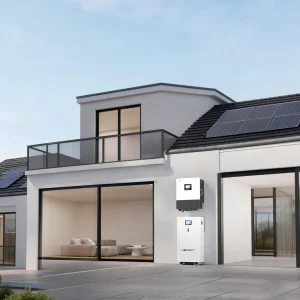
In a grid utility, you don’t have to worry about the energy. When your appliances operate simultaneously, the grid provides the energy. But in the off-grid system, the scenario is different.
A few factors determine the need for a right-sized inverter.
Continuous Power Demands
If you are installing off-grid inverters at your home, calculate the power demands. The simultaneous operation and the total power add up to the continuous power demand. It is essential to handle daily needs. Therefore, you should have the right-sized inverter for this power demand.
Peak Demands
Continuous power demand is the daily need. Sometimes, when operating an appliance, power surges occur. These surges can cause a potential failure if your inverter can’t handle it. Therefore, you should consider the peak demands when sizing your inverters and choose a suitable inverter size.
Future Increases
As time passes, the demands increase. In the future, you might deploy more appliances in your home and need more power. Choosing an inverter larger than required can help accommodate future increases and ensure a safe setup that meets your needs.
Seasonal Energy Fluctuations
Energy demand fluctuates with the seasons. For example, the summer season requires more energy compared to the winter season. Only inverters and batteries of the correct size can safely and efficiently power the home appliances. Therefore, you should consider the correct size.
How Do You Calculate the Right Size of the Solar Inverter?
If you are wondering how to calculate the size of your solar inverter, you should know your daily usage and peak surges. Here are three steps to evaluate essential energy requirements.
Step 1: Calculate Your Daily Energy Usage
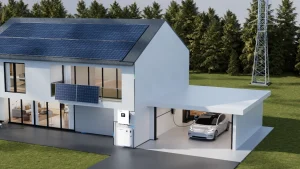
Daily energy usage depends on the number of appliances and their daily consumption. Remember, it doesn’t tell you about daily usage, but it helps you estimate energy production and needs with your battery storage.
Suppose an example of the following devices and their energy calculation.
- Refrigerator: 1.5 kWh/day
- Lighting: 2 kWh/day
- Television: 1 kWh/day
- Washing machine: 1 kWh/day
- Water pump: 1.5 kWh/day
- Microwave: 1 kWh/day
- Air conditioner: 6 kWh/day
When you combine these power consumptions, the total energy needed is 14kWh per day.
It means your solar arrays should produce that much energy to operate all your devices simultaneously. Similarly, you should purchase a solar inverter that can handle more energy than this one.
Step 2: Determine Your Peak Load
Peak load is the maximum power your device uses. It reports the maximum energy consumption of a single device.
Here is how you should understand the peak load.
- Refrigerator: 300W
- Microwave: 1,200W
- Water pump: 1,000W
- Air conditioner: 3,000W
- Lights and electronics: 500W
The total peak load is 6kW. Most experts recommend buying a solar inverter with more power than the peak load. They recommend a safety margin of 20%. It means if you have a peak load of 6kW, your inverter should be above 7.2kW.
Step 3: Consider Surge Loads
Surge load is the maximum power surge during operation. Most devices require more power during their start.
For example, here is a list of devices that require surge power.
- Refrigerators
- Well pumps
- Air conditioners
- Power tools
- Compressors
These devices might require more power at the start. For instance, the refrigerator might take a 1000W surge load compared to its continuous 300W power consumption.
Typical Inverter Sizes for Off-Grid Homes
In the US, residential homes install a typical range of inverters to meet their needs. Depending on energy needs and options, there are four different capacities and ranges for off-grid solar inverters.
5kW–8kW Inverter
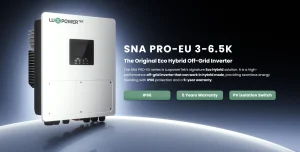
5-8kW inverters are a sufficient capacity for a smaller home. Such inverters are sufficient to operate the basic home appliances, such as refrigerators, lights, electronics, and small appliances.
You should install such inverters in the following applications.
- Small cabins
- Tiny homes
- Vacation properties
- Energy-efficient households
8kW–12kW Inverter
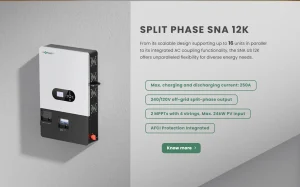
Medium homes require more operations than smaller homes. They have multiple appliances, including two refrigerators, an air conditioner, and more.
They have higher energy demands. An 8- 12kW inverter is sufficient for them and offers a good application in:
- Multiple refrigerators
- Air conditioning
- Kitchen appliances
- Laundry equipment
- Entertainment systems
12kW–16kW Inverter
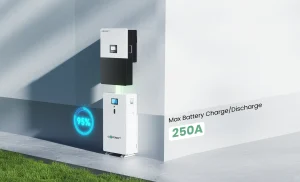
Do you own a large home? Depending on the power consumption and appliances, a 12-16kW solar inverter is enough for your needs. It can support multiple large appliances and provides power to heavy-duty electrical tools.
It is the best option for:
- Large family homes
- Farms and ranches
- Properties with workshops
20kW–25kW Inverter
-300x143.webp)
A 20-25kW setup is large enough to operate heavy-duty tools and an HVAC system. However, it is ideal for either larger homes with future expansion or commercial setups with higher energy needs.
Here are a few unique applications for such a system.
- Luxury homes
- Multi-family properties
- Agricultural facilities
- Commercial-residential hybrid systems
How to Choose the Right Size of Your Inverter?
-300x270.webp)
When setting up a solar inverter system, the right size is essential. Here are typical off-grid home sizes to consider.
For Energy Efficient Homes
Do you want to save money and enjoy an energy-efficient system?
An 8-10kW solar inverter is sufficient for many reasons for efficient homes. This is because of the following benefits.
- It offers affordable prices.
- The energy efficiency is excellent, resulting in lower energy costs.
- It meets the energy needs for homes and cabins.
For Small to Medium Off-Grid Homes
Small to medium off-grid homes require daily energy for their operations. Many appliances operate simultaneously. For such a home, you should have a reliable 12kW solar inverter to meet your needs.
It offers the following benefits.
- Split-phase output for US homes
- Hybrid operation
- Battery integration capability
- Backup power functionality
- Suitable for medium-sized residences
For High Power Residential Applications
High-Power Residential Applications require an affordable yet energy-efficient system. For such applications, a 13kW solar inverter offers both the pricing and efficiency.
Therefore, it is suitable for the following applications.
- Growing families
- High appliance usage
- Future solar expansion
For Large Residential Applications
Do you have large residential applications to operate? Perfect! A higher energy need is more important in such a system. To meet energy needs, you should deploy solar inverters capable of handling peak energy.
Usually, a 16kW solar inverter is sufficient in such a case and affordable for the following applications.
- Large households
- Homes with central HVAC
- Well pumps
- Workshops and garages
For Maximum Energy Independence
If you own a luxury home or have a large number of appliances, maximum energy independence is your best option. For that, you should set up a high-power solar inverter system up to 25kW.
Such a system provides a balanced energy supply for the following applications.
- Luxury off-grid homes
- Farms
- Ranches
- Multi-building properties
- Heavy-duty energy requirements
FAQs
- Can I integrate multiple inverters in a single solar setup at home?
Yes, you can join and operate multiple inverters in parallel to increase the capacity of your off-grid system. However, make sure the operations are correct.
- Is it beneficial if I oversize the solar off-grid inverter?
It depends on how much you oversize. If you oversize moderately, that is great. Your inverters can operate smoothly and efficiently.
- How do you calculate the size of an off-grid solar inverter?
For the right off-grid inverter size, list all appliances and their operational power. Keep a 20% safety margin and buy the solar setup based on the total wattage.
- Can a 10kW inverter run an entire house?
Yes, it can if the house’s average consumption is mild to moderate. For extensive energy operations, you should consider higher power inverters.
- What size is the typical off-grid setup in the USA?
In the USA, small to medium homes deploy an 8-10kW inverter. At the same time, larger homes might include 16-20kW solar inverters for smooth operation.
Conclusion
Whenever you are installing an off-grid setup at your home or commercial sectors, you should calculate the average power consumption. Instead of buying inverters to the exact capacity, you should allow a safety margin and buy an inverter with a higher capacity.
Do you want to grab high-end inverters with top-notch efficiency? Luxpowertek is here for you. We have more than a decade of experience and manufacture premium-quality solar inverters. Our off-grid solar setup is sufficient for your home in the USA. Contact our experts right away!