
When choosing between a split-phase and single-phase inverter, start with the property’s electrical service rather than the inverter’s headline power rating. In electrical terms, split-phase is a type of single-phase distribution. In product classifications, “single-phase inverter” commonly refers to 220–240V models used in Europe and similar markets, while “split-phase inverter” usually refers to North American 120/240V models. Because terminology can vary by market, always check the utility service and the exact inverter datasheet before making a selection.
At LuxpowerTek, we organize our inverter range around regional grid standards and system architecture. Our recommendation is to first confirm the service voltage, then map the backup loads and match the inverter with a compatible battery system.
What Is the Difference Between Single-Phase and Split-Phase Inverters?
How a single-phase inverter works
A single-phase inverter supplies alternating current through one AC phase. In many residential markets, that means a nominal 220V or 230V connection. The inverter converts solar and battery energy into usable AC power while managing the relationship between the home, grid, and battery.
Single-phase systems fit properties with matching service and a backup plan focused on selected circuits or moderate demand. Lighting, refrigeration, communications equipment, computers, and ordinary outlets are common examples, but the actual load must be measured.
How a split-phase inverter works
A split-phase system provides two 120V legs that are opposite in phase. A 120V appliance uses one leg and neutral, while a 240V appliance uses both legs. Common in North American homes, this arrangement serves standard circuits alongside equipment such as air conditioners, pumps, heat pumps, and EV chargers.
A split-phase inverter must do more than deliver enough kilowatts. It must match the 120/240V arrangement, coordinate with the service panel, and support the selected backup loads. A 120V-only unit cannot directly operate a 240V load, even when its power rating looks sufficient.
Why the local grid standard comes first
Voltage and phase requirements vary by country and utility region. A European 230V home should not use a North American split-phase model, while a North American 120/240V home needs the correct architecture. Confirm service voltage, frequency, meter arrangement, and certifications before comparing products.
Split-Phase vs Single-Phase Inverter: Key Differences
| Selection factor | 単相インバータ | 分割相インバータ |
| Typical electrical architecture | One AC phase, often used with 220–240V residential service. | Two 120V legs that can supply 120V and 240V loads in a North American system. |
| Best starting point | A property with single-phase utility service and standard household loads. | A property with 120/240V service, 240V appliances, or a whole-home backup plan. |
| Load planning | Check continuous demand, surge demand, and the circuits included in backup. | Check both legs, phase balance, 240V loads, continuous demand, and motor-starting surge. |
| インストールの複雑さ | Usually simpler when the service and loads already match the inverter. | Often requires more detailed panel, phase-balance, transfer-equipment, and local-code planning. |
| Critical compatibility checks | AC voltage, battery voltage, PV input, battery communication, and local grid rules. | 120/240V output, service-panel wiring, transfer equipment, battery compatibility, and local approvals. |
Output voltage matters as much as rated power
Comparing only 8kW, 10kW, or 12kW labels can lead to the wrong system. A 10kW inverter with the wrong output architecture will not solve a 240V load problem. Our recommendation is to list each large appliance’s required voltage before comparing models.
Backup scope changes the decision
Single-phase installations often use a critical-load panel. Split-phase systems can support more household circuits when the inverter, battery, panel, and transfer equipment are designed together. Whole-home backup still depends on rated output and battery discharge capability. Air conditioners, pumps, and compressors may draw much more power at startup.
Backup power also has a switching-time requirement. Equipment that cannot tolerate a brief transfer should use a dedicated UPS upstream. A hybrid inverter and battery system can keep compatible loads running during an outage, but it is not automatically a zero-interruption UPS.
System expansion requires model-level verification
PV input, MPPT design, battery voltage, charge and discharge current, generator input, smart-load control, and parallel operation all vary by model. Before preparing a quotation, match the exact inverter and market version with the latest datasheet, user manual, and compatibility documents.
How LuxpowerTek Organizes Single-Phase and Split-Phase Inverter Options
私たちの product range covers single-phase, split-phase, and three-phase inverters, together with hybrid, off-grid, AC-coupled, DC-coupled, all-in-one, battery, and monitoring solutions. We organize these products by grid architecture, destination market, and application, helping installers match system capacity and functionality with the project’s actual energy requirements.
Single-phase inverter options for 220–240V systems
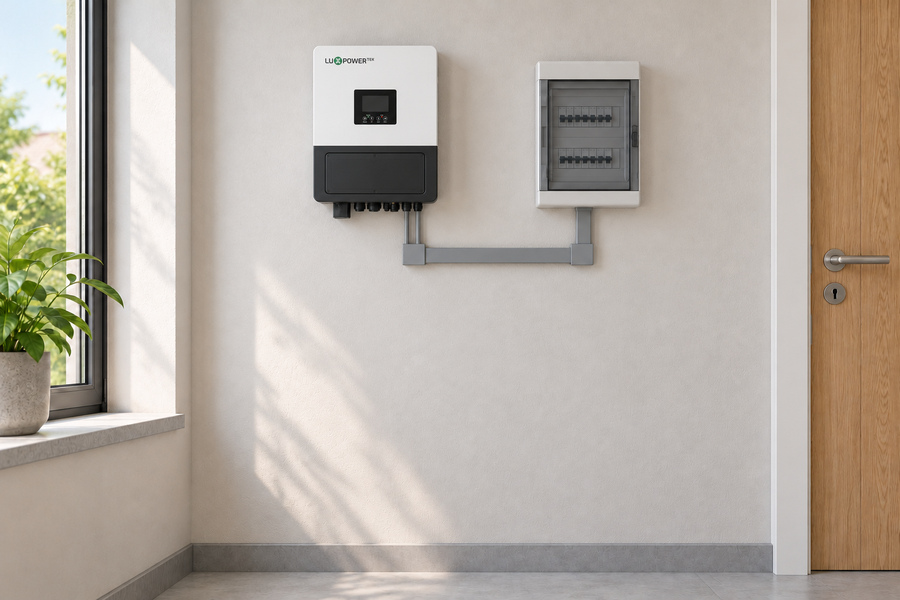
For a 220–240V project where installation space and future growth both matter, the GEN3-LB-EU 3-8K brings together a compact design and strong expansion capability. It delivers up to 8kW of rated output, accepts up to 12kW of PV input, supports up to 180A of charge and discharge current, and allows up to 16 units to operate in parallel. Two independent MPPTs and IP66 protection give installers added flexibility for different roof layouts, residential storage, workshops, and small commercial projects.
When a system includes multiple PV orientations or requires faster battery charging and discharging, the GEN PRO-LB-EU 8-12K provides a higher-capacity platform. Its three independent MPPT inputs help manage more complex PV layouts, while charge and discharge current of up to 270A supports larger battery systems. The dedicated GEN port simplifies generator integration, and IP66 protection adds installation flexibility for projects with higher single-phase loads and more advanced energy-management needs.
Split-phase inverter options for North American 120/240V systems
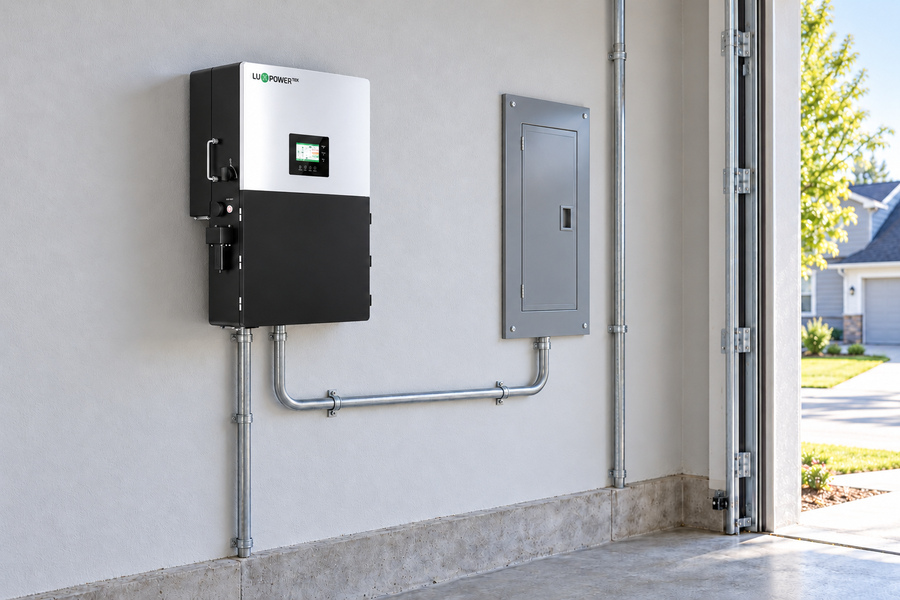
North American whole-home backup requires an inverter that can manage both 120V and 240V loads within the same system. The GEN-LB-US 9.6KPRO/12KPRO/13KPRO/16K series connects solar panels, batteries, the grid, generators, and smart loads for 120/240V split-phase applications. Depending on the selected model, it offers up to 25kW of PV input, up to 250A of battery current, and a built-in 400A battery breaker. This combination supports large residential solar and storage, high-load off-grid projects, whole-home backup, and upgrades to existing grid-tied systems.
For off-grid and essential-load applications, the SNA US 6K provides a compact 120/240V solution with 6kW of EPS output, a dedicated generator interface, AFCI protection, and support for up to 16 units in parallel. Its dedicated port can also support AC coupling or smart-load management. When the project requires more output and greater PV capacity, the SNA US 12K raises the output to 12kW and supports up to 24kW of PV input, 250A of charge and discharge current, two MPPTs with four strings, and a 100A passthrough capability.
We select between these product families by looking at the property’s grid architecture first, then comparing load demand, backup coverage, PV capacity, battery performance, generator requirements, and future expansion plans. The relevant datasheet and installation documents provide the final specifications for each model.
Match the Inverter to Your Electrical Service
The right inverter starts with the property’s electrical architecture. Once the service voltage and main loads are clear, it becomes easier to decide which inverter family, battery system, and backup configuration will work together.
220–240V single-phase projects
For a 220–240V single-phase home or small business, a single-phase inverter is usually the natural starting point. This configuration works well for standard household loads, selected-circuit backup, solar self-consumption, time-of-use energy management, and gradual battery expansion.
The design should still account for continuous demand, motor-starting surge, battery voltage, PV string configuration, and local grid requirements. Homes with large pumps, compressors, or North American-style 240V appliances may require a different system architecture.
120/240V split-phase projects
A 120/240V split-phase inverter is suited to North American properties that use both 120V and 240V circuits. It is commonly considered for homes with central air conditioning, well pumps, electric water heating, workshop equipment, EV charging, or other high-load appliances.
This architecture also provides a stronger foundation for whole-home backup, provided that the inverter, battery, service panel, bypass path, and transfer equipment are sized together. Supporting both voltage levels may require more battery capacity and more detailed phase-balance planning than a selected-load system.
Six Checks to Complete Before Ordering
- Confirm the utility service: identify the voltage, phase arrangement, frequency, meter type, and service-panel configuration.
- List the important loads: separate 120V, 230V, and 240V equipment where applicable, then record running and startup power.
- Define the backup boundary: decide whether the system protects selected circuits, essential loads, or the whole home.
- Size the PV input: check maximum PV power, MPPT voltage range, string current, and the number of independent MPPT inputs.
- Match the battery: confirm voltage range, chemistry, maximum current, BMS communication, and the battery compatibility list for the market.
- Verify installation requirements: review local approvals, generator or smart-load connections, parallel operation, transfer equipment, and the latest model manual.
Use the latest market-specific datasheets, user manuals, and LuxpowerTek battery compatibility lists to complete the final system check.
よくある質問
Can a 220–240V single-phase inverter power a North American 240V appliance?
Only when the system is specifically designed and approved to provide the required 240V output. A 220–240V single-phase output is not automatically equivalent to a North American 120/240V split-phase service. Confirm the output arrangement, neutral connection, phase synchronization, service panel, transfer equipment, and local certifications. Do not choose an inverter for a 240V appliance based only on the word “single-phase” or its kW rating.
Can two single-phase inverters create a split-phase system?
Only when the selected inverters support the manufacturer’s split-phase configuration. Parallel operation alone is not enough: the system may require phase synchronization, inverter-to-inverter communication, compatible neutral and grounding arrangements, suitable breakers and transfer equipment, and compliance with the applicable market’s installation rules. Two inverters cannot be assumed to create a safe 120/240V supply simply because their power ratings can be added together.
Is a split-phase inverter always better?
No. Split-phase is better when the electrical service and loads require it. A properly sized single-phase inverter is often the more suitable choice for a single-phase property with ordinary residential demand.
What should I send to LuxpowerTek before asking for a model recommendation?
Prepare the country and utility voltage, major loads, backup circuits, PV size, battery model or chemistry, generator requirements, and whether 240V equipment must operate during an outage. These details help our team identify the correct product category and required documents. You can also contact LuxpowerTek for product and support guidance.
Conclusion: Choose the Electrical Architecture First
The decision between a split-phase vs single-phase inverter is mainly a question of electrical compatibility. Single-phase systems suit matching service and standard household loads. Split-phase systems suit 120/240V properties, 240V equipment, and broader whole-home backup. Start with the utility connection, map the loads, define the backup boundary, and compare the exact LuxpowerTek model, battery, and installation requirements.